by Kaykobad Hossain
This week’s journal club focuses on a study from Nature Communications (2026) proposing that nerve growth factor (NGF) is the driver of ILC2 pro-tumoral functions in patients with bladder cancer.
The study explores how interactions between immune cells within the tumor microenvironment contribute to the progression of bladder cancer, focusing specifically on mast cells and group 2 innate lymphoid cells (ILC2s). While both cell types are typically associated with immune defense and tissue repair, the authors demonstrate that they can also promote tumor growth under certain conditions.
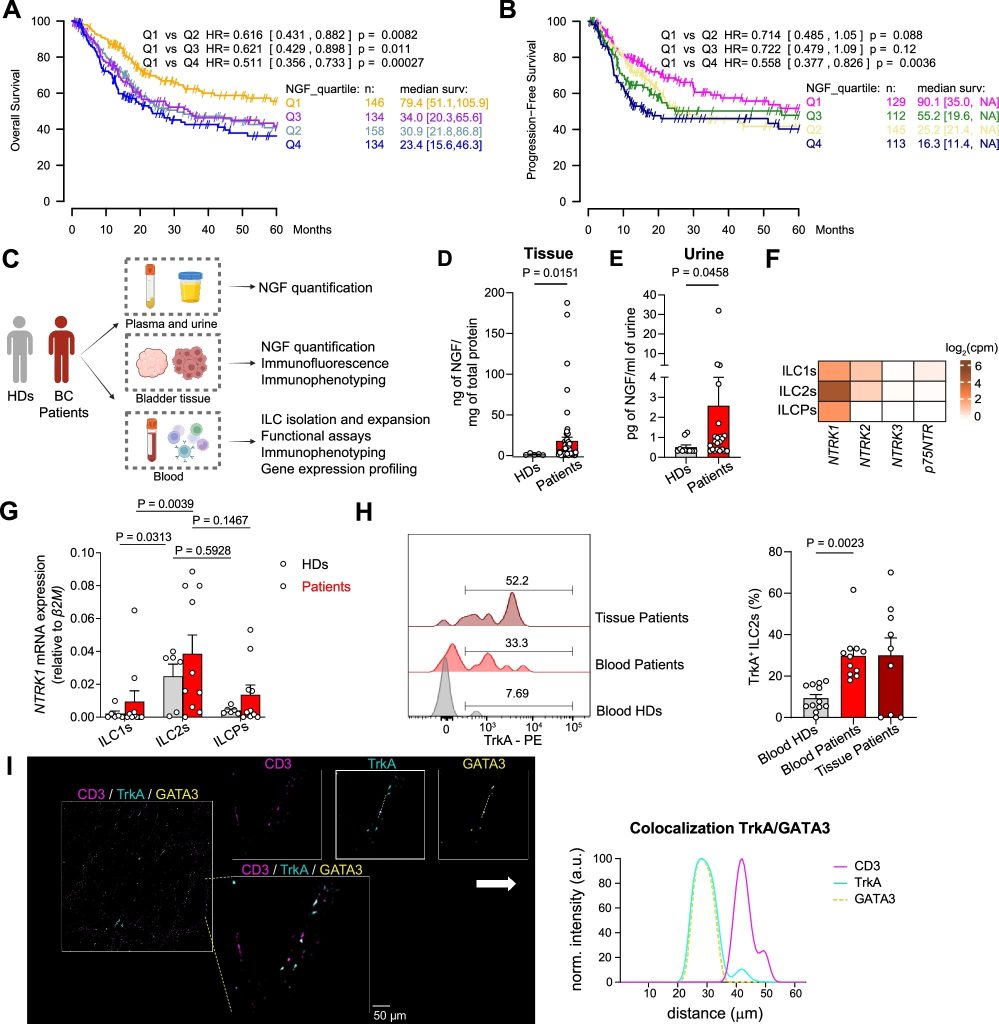
The researchers found that mast cells infiltrating bladder tumors produce high levels of nerve growth factor (NGF), a signaling molecule traditionally known for its role in neuronal development and survival. In tumors, NGF acts as a key mediator that influences nearby immune cells. The study shows that ILC2s express receptors for NGF, making them responsive to mast cell-derived signals.
Upon stimulation by NGF, ILC2s undergo functional changes that enhance their pro-tumoral activity. Specifically, NGF signaling increases the production of type 2 cytokines such as IL-5 and IL-13 by ILC2s. These cytokines are known to shape the tumor microenvironment in ways that suppress effective anti-tumor immune responses and promote tissue remodeling, angiogenesis, and tumor growth. As a result, ILC2s shift from a potentially protective immune role to one that supports cancer progression.
They also demonstrate that this mast cell ILC2 axis correlates with worse clinical outcomes in bladder cancer patients. Tumor samples with higher levels of mast cells, NGF, and activated ILC2s were associated with more aggressive disease features. This suggests that the interaction is not only biologically significant but also clinically relevant.
Mechanistically, the researchers identified that NGF binds to its receptor (likely TrkA) on ILC2s, activating downstream signaling pathways that enhance their survival, proliferation, and cytokine production. Blocking NGF signaling, either genetically or pharmacologically, reduced ILC2 activation and diminished their pro-tumoral effects in experimental models. This indicates that disrupting this pathway could be a potential therapeutic strategy.
Importantly, the study highlights the plasticity of immune cells in the tumor microenvironment. Rather than acting strictly as defenders against cancer, cells like mast cells and ILC2s can be coopted by tumors to support their growth. The findings emphasize the importance of understanding cell-to-cell communication within tumors, as these interactions can significantly influence disease progression.
In summary, the study demonstrates a novel mechanism in which mast cell-derived NGF drives the pro-tumoral functions of ILC2s in bladder cancer. Targeting the NGF-ILC2 axis may offer new opportunities for therapeutic intervention in bladder cancer, particularly in cases where conventional treatments are insufficient.
Continue your reading here:
Mast-cell derived nerve growth factor drives ILC2 pro-tumoral functions in bladder cancer
Falquet M, El Ahanidi H, Gomez-Cadena A, Su Z, Cornu A, Wyss T, Kizil B, Pick R, Falamaki K, Wirapati P, Fiordi B, Senoner I, Maresca DC, Kallal N, Guedj D, Kreutzfeldt M, Tille JC, Leblond MM, Michaud K, Pesce S, Candiani S, Golebski K, Dagher J, Charrier M, Pressacco Brossier C, Grobet-Jeandin E, Marone R, Hugues S, Jeker LT, Verdeil G, Merkler D, Marcenaro E, Scheiermann C, Attaleb M, Benamran D, Tsantoulis P, Ercolano G, Trabanelli S, Jandus C.
Nature Communications 2026 Feb 21;17(1):3061. doi: 10.1038/s41467-026-69841-y