
by Olena Kondratska
This week’s journal club focuses on a study from Transl Psychiatry (2026) reporting on astrocytic dysfunction within the cerebellum suggesting a widespread disruption of astrocyte-mediated communication across the brain in depression.
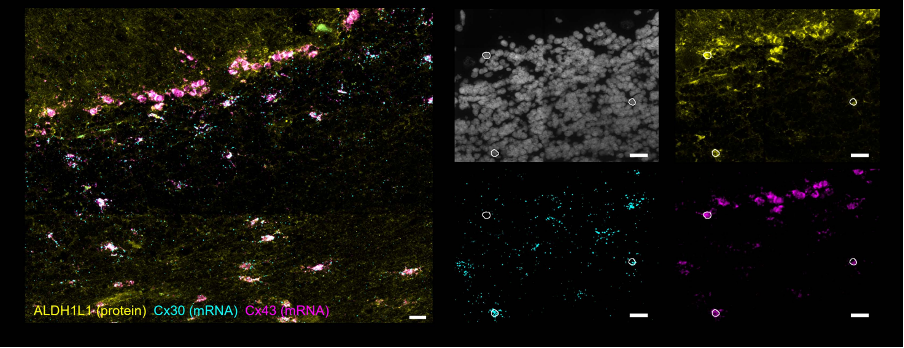
While depression and suicide are multifactorial, multiple reports have suggested astrocytic alterations mainly in frontal-limbic brain regions. These changes indicate altered astrocyte morphology and densities in depressed individuals, while of cerebellar-cerebral circuit was less investigated. In the recent paper authors quantified the changes of astrocytic subpopulations in distinct cerebellar layers in Crus I using two canonical markers, i.e. glial fibrillary acidic protein (GFAP) and aldehyde Dehydrogenase – 1 Family member L1 (ALDH1L1), as well as analyzed the expression of astrocytic connexins (Cx30 and Cx43), proteins essential for gap-junction-mediated intercellular signaling in tissue from depressive individuals who dies from suicide (DS).
Formalin-fixed tissue blocks were used for stereology which included 21 CTRL and 20 DS fresh -frozen tissues from a subset of the same subjects were used for fluorescence in situ hybridization (FISH), RNAscope (16 CTRL, 18 DS, see Table 2 for subject characteristics).
Applying labeling of GFAP and ALDH1L1⁺ astrocytes they found the significant increase of ALDH1L1⁺ astrocytes densities in in the Purkinje cell layer (PCL) of DS individuals compared with controls.
The density of ALDH1L1⁺ astrocytes (a broad marker of astrocytes) was significantly increased in the Purkinje cell layer (PCL) of DS individuals compared with controls. This suggests a region-specific change in astrocyte populations in depression.
Expression of astrocytic connexins—especially Cx43—was significantly reduced in both the PCL and granule cell layer (GCL) of depressed individuals. This indicates impaired astrocyte-to-astrocyte communication in key cerebellar circuits.
While Cx43 (Connexin 43 / GJA1) is the most abundant connexin in astrocytes, expressed throughout gray and white matter, including both Purkinje layer (Bergmann glia) and granule layer, the decreased level of Cx43 would suggest alterations to astrocyte–astrocyte gap junctions in the particular brain region. The Cx30 (Connexin 30 / GJB6) predominantly expressed in gray matter astrocytes and Bergmann glia, and maintain astrocytic network synchronization and support intercellular ion/metabolite exchange. Downregulation of both types of connexins suggests disruption of both global and local astrocytic communication in the cerebellum.
Continue your reading here:
Cerebellar astrocytic alterations in depression
Hercher C, Abajian G, Davoli MA, Turecki G, Mechawar N
Transl Psychiatry. 2026 Feb 9. doi: 10.1038/s41398-026-03866-1