“Cyborg-lite” pancreatic organoids
by Ulrik Larsen
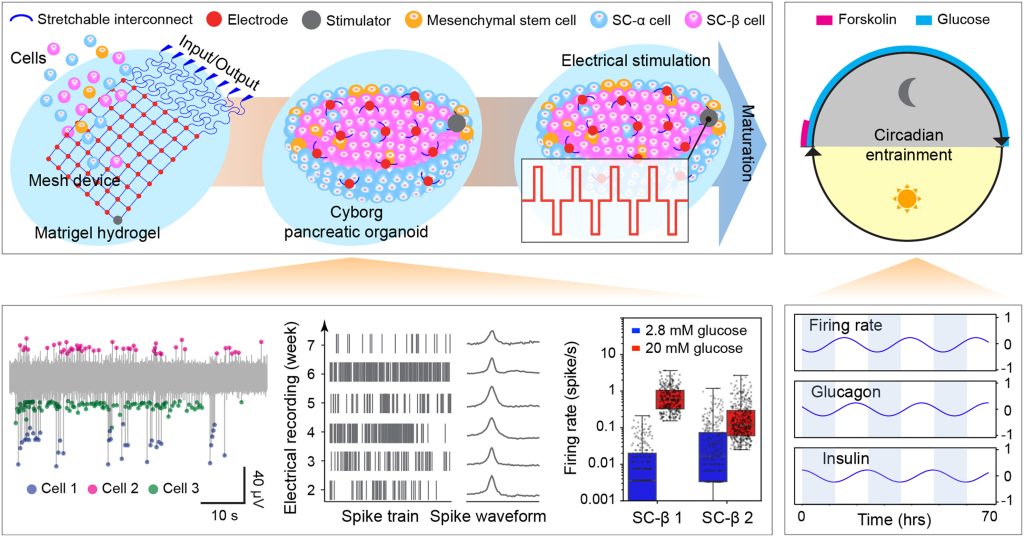
This study integrates flexible, mesh nanoelectronics into stem-cell–derived pancreatic organoids, enabling long-term, single-cell electrophysiology within intact 3D tissue. Previous approaches were limited by rigid, 2D devices that disrupted organoid development and only captured surface-level or bulk activity. By embedding soft electronics at the endocrine progenitor stage (adapted from the Douglas Melton protocol), the authors achieve stable, distributed recording and stimulation throughout the organoid.
Using spike sorting, they resolve electrical activity from individual SC-α and SC-β cells simultaneously, distinguishing them by their characteristic glucose responses. Pharmacological perturbations (shown in Table 1) validate these identities, and links electrical signatures to transcriptional cell types. Tracking cells throughout maturation reveals that both SC-α and SC-β cells occupy distinct electrical states (low vs. high basal firing), and that the improvement in function comes from more cells entering the correct electrical state, not from all cells gradually improving (transcriptionally).
The system also enables functional interrogation. Circadian entrainment synchronizes electrical oscillations across α- and β-cells, producing coordinated hormone secretion rhythms. Additionally, embedded stimulators show that electrical stimulation can enhance glucose responsiveness by promoting faster and more synchronous activity.
Overall, the work demonstrates that islet maturation is not purely transcriptional but involves dynamic, coordinated electrical state transitions that can, by using the nanoelectronics mesh device, be monitored and potentially modulated in real time.
One additional experiment could have been to investigate/identify non–α/β populations (e.g., δ-cells), which spatial transcriptomics alone could not fully resolve (though this I know would be quite difficult). Could combining electrophysiological signatures with immunostaining improve cell-type classification? Another topic, would applying a more mature differentiation strategy, such as that from Timo Otonkoski, reduce the need for external modulation (e.g., stimulation or entrainment), or instead further enhance these electrophysical maturation processes?
Table 1: Manipulation of the electrophysiology of SC-β and SC-α cells
| Pharmacological perturbations | Expected β-cell response | Expected α-cell response |
| High glucose1 / Low glucose2 | Activated1 / Inhibited2 | Inhibited1 / Activated2 |
| Diazoxide | Inhibited | Not affected |
| Tolbutamide | Activated | Inhibited |
| Ca2+ block | Inhibited | Inhibited |
Continue your reading here:
Implanted flexible electronics reveal principles of human islet cell electrical maturation
Li Q, Liu R, Lin Z, Zhang X, Wang W, Galicia-Silva IM, Liu M, Gao Z, Pollock SD, Alvarez-Dominguez JR, Liu J.
Science. 2026 Feb 19;391(6787):eaeb3295. doi: 10.1126/science.aeb3295. Epub 2026 Feb 19. PMID: 41712726