
by Olena Kondratska
This week’s journal club focuses on a study from Scientific Reports (2026) investigating the neuroprotective effects of D-mannose in a rotenone-induced mouse model of Parkinson’s disease.
Parkinson’s disease (PD) is a complex neurodegenerative disorder characterized primarily by motor dysfunction, including tremors, bradykinesia, and muscle rigidity. These symptoms are largely attributed to the degeneration of dopaminergic neurons in the substantia nigra (SN). Although the exact pathological mechanisms underlying PD are not fully understood, several contributing factors have been proposed. These include the abnormal accumulation of α-synuclein, oxidative stress and excitotoxicity, structural and functional protein abnormalities caused by genetic mutations, mitochondrial dysfunction, neuroinflammatory responses, and disruption of gut–brain axis communication.
Increasing evidence suggests that dysfunction of the gut–brain axis plays a significant role in the development of PD. Notably, some studies indicate that PD may originate in the gastrointestinal tract. In this context, misfolded α-synuclein is thought to spread from the intestinal nervous system to the central nervous system via the vagus nerve, contributing to disease progression. As a result, the gut–brain axis has become a major focus of recent PD research.
In this paper authours investigate the neuroprotective effects of D-mannose in a rotenone-induced mouse model of Parkinson’s disease (PD). The experimental design included three groups: a control group, a rotenone-treated group (receiving oral rotenone for four weeks), and a rotenone + D-mannose group, in which D-mannose treatment was administered for two weeks following rotenone exposure.
A range of assessments was conducted, including analyses of motor function, neuronal damage, gut microbiota composition, inflammation, and intestinal barrier integrity. The methodological approach involved behavioral testing (such as the rotarod and adhesive stick removal tests), immunohistochemitry examination of dopaminergic neurons in the substantia nigra, histology, and 16S rRNA gene sequencing to evaluate gut microbiota profiles.
The findings indicate that D-mannose treatment following rotenone exposure led to significant improvements in motor performance and a reduction in PD-like behavioral deficits. Additionally, D-mannose exerted a neuroprotective effect, preserving dopaminergic neurons in the brain, as demonstrated in Figure 2.
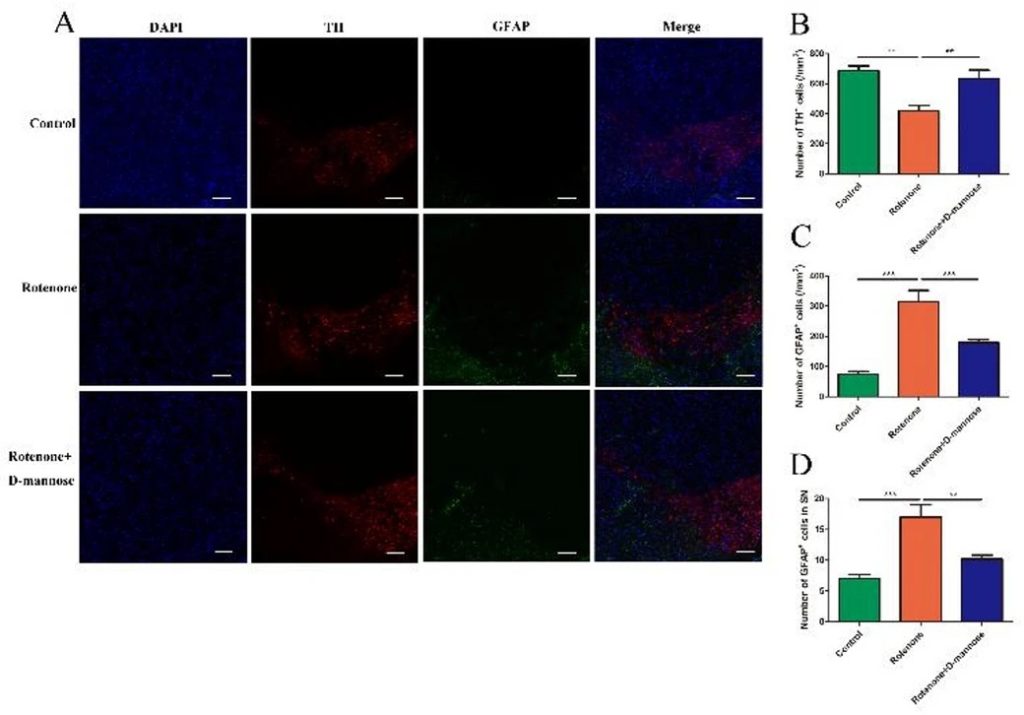
In addition, rotenone exposure led to an increased number of activated astrocytes and elevated Iba1 expression, indicating microglial activation, whereas D-mannose treatment significantly attenuated these effects, suggesting reduced neuroinflammation.
Continue your reading here:
D-mannose alleviates rotenone-induced PD mouse model through microbiota-gut-brain axis
Yan Hong, Chang Ge, Jing Jin, Yifei Gao1 & Yan Tang
Sci Rep 16, 5680 (2026). DOI: 10.1038/s41598-026-36272-0