This week’s journal club focuses on a study from Science Advances (2022) describing how predator-prey evolution has generated several somatostatin analogs used in venoms.
by Lucas Unger
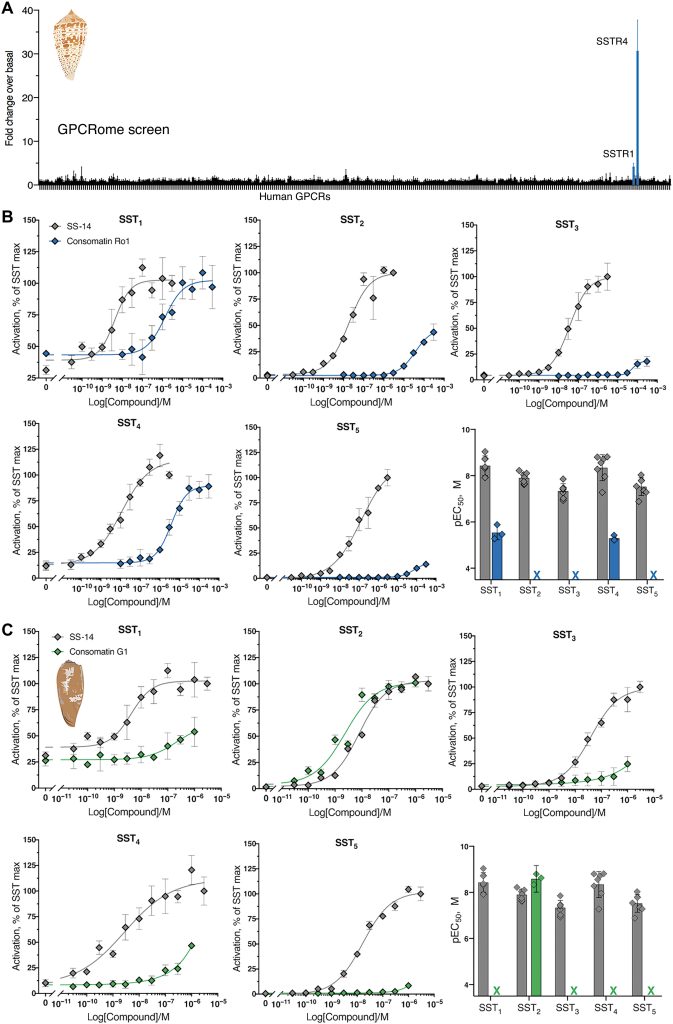
Ramiro et al. show that deep-sea, fish-hunting cone snails use venom peptides called consomatins that closely mimic the hormone somatostatin. By injecting these peptides, the snails slowly reduce movement and pain perception in fish, allowing a low-risk ambush. One of these peptides, Consomatin Ro1, is structurally and functionally similar to somatostatin drug analogs like octreotide, but whereas octreotide preferentially activates SSTR2, Ro1 selectively activates SSTR1 and SSTR4, while related consomatins can target SSTR2, which controls pancreatic hormone secretion in humans. These hormone-mimicking venom peptides illustrate how evolution can repurpose hormone pathways and offer new tools for studying somatostatin signaling.
Continue your reading here:
Ramiro IBL, Bjørn-Yoshimoto WE, Imperial JS, Gajewiak J, Salcedo PF, Watkins M, Taylor D, Resager W, Ueberheide B, Bräuner-Osborne H, Whitby FG, Hill CP, Martin LF, Patwardhan A, Concepcion GP, Olivera BM, Safavi-Hemami H. Somatostatin venom analogs evolved by fish-hunting cone snails: From prey capture behavior to identifying drug leads
Science Advances 2022 Mar 25;8(12):eabk1410. doi: 10.1126/sciadv.abk1410. PMID: 35319982